Romance
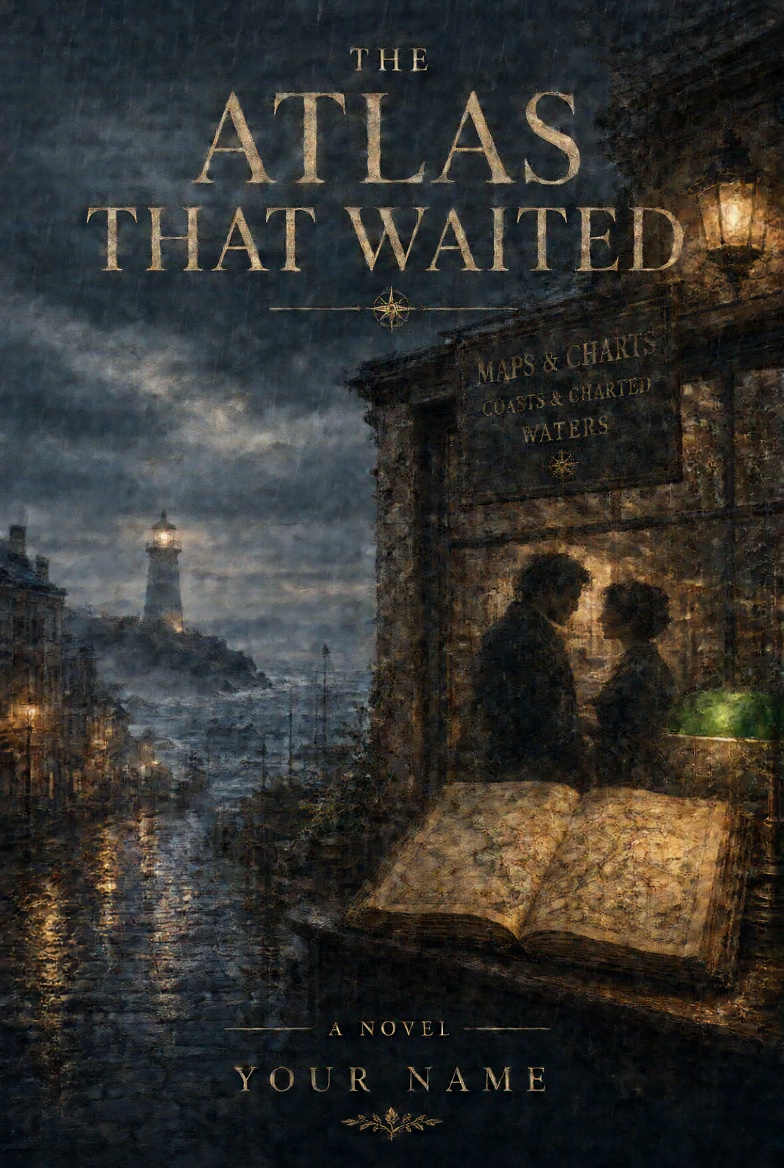
The Atlas That Waited
13+ TeenAI-assisted
The Atlas That Waited
The rain had been falling since dawn, soft and relentless, turning the cobbled streets of Port Merrow into mirrors. Solenne March stood under the awning of the old map shop, arms folded tight against the chill, watching the harbor lights blur. She had come for the atlas. Not just any atlas. The 1789 coastal survey that had vanished from her grandfather’s collection twenty years ago and now sat in the window of Crowe & Sons with a handwritten tag that read Price upon inquiry.
She pushed the door open. A bell above it gave a single, tired note.
The shop smelled of paper, sea salt, and something warmer, like beeswax. Shelves rose to the ceiling, crowded with rolled charts and leather-bound volumes. At the far end, a man bent over a long table under a green-shaded lamp. He did not look up at once.
“We’re closed,” he said. His voice was low, roughened by the kind of silence that comes from living alone too long.
“The sign says open until eight.”
He raised his head then. Dark hair fell across his forehead. His eyes were the color of wet slate, and they held her for a moment longer than politeness required. “Sign’s wrong. Has been for years.”
Solenne stepped farther in, water dripping from her coat onto the worn floorboards. “I’m here for the coastal survey in the window. The 1789.”
He straightened slowly. “That one’s not for sale.”
“Everything has a price.”
“Not that.” He wiped his hands on a rag, leaving dark smudges. “It’s part of the shop. Always has been.”
She moved closer to the window display, careful not to touch the glass. The atlas lay open to a detailed chart of the Merrow coastline, ink faded to soft brown, the paper foxed at the edges. Her grandfather’s marginal notes were still there in the lower corner, the tiny star he used to mark places he had actually walked.
“It belonged to my family,” she said quietly. “I can prove it.”
The man came around the table. He was taller than she expected, broad through the shoulders in the way of someone who had spent years lifting heavy things. “Name?”
“Solenne March.”
Something shifted in his face. Not recognition exactly. Something closer to caution. “Evander Crowe. This place has been mine for twelve years. Before that, my father’s. Before that, my grandfather’s. That atlas has sat in that window since before I was born. No one ever asked for it by name until tonight.”
Rain tapped harder against the glass. Somewhere in the harbor a buoy clanged once, twice.
Solenne reached into her coat and drew out a thin folder, the kind that protected old photographs. She opened it on the edge of the table. Inside was a single photograph of a younger man standing on the same pier outside, holding the same atlas open. Behind him the shop sign read Crowe & Sons in fresher paint.
Evander stared at the photograph for a long time. When he spoke again his voice had lost some of its edge. “Your grandfather was the one who used to come in every Tuesday. Brought my grandfather coffee. They argued about currents for hours.”
“He left me the rest of the collection when he died. Everything except this.” She touched the edge of the atlas through the glass with one finger. “I thought it was lost.”
Evander exhaled through his nose. “It wasn’t lost. It was waiting.”
He unlocked the display case with a key from his pocket and lifted the atlas out as if it might break. The leather binding was cracked along the spine. He set it on the table between them and turned to the page with the star. Solenne’s breath caught. The paper still smelled faintly of the sea and of the tobacco her grandfather had preferred.
“I can’t sell it to you,” Evander said. “But I can let you look at it. Properly. Without the glass.”
She looked up. “Why?”
“Because your grandfather kept the coffee coming even after my grandfather stopped arguing back. And because you walked in here in the rain like you’d been looking for this place your whole life.”
Outside the wind shifted. A gust rattled the windows. Solenne realized she was still dripping on the floor.
“There’s a kettle in the back,” Evander said. “If you want tea while you look.”
She should have said no. She had a train to catch in the morning, a restoration job waiting in the city, a life that did not include strange men in map shops who spoke as if time moved differently inside these walls. Instead she nodded.
They sat at the long table with the atlas between them and two mismatched mugs of strong black tea. Evander turned pages with the care of someone who had done it a thousand times. Solenne pointed out the places her grandfather had marked. He pointed out the places the original surveyor had gotten wrong. Their hands never quite touched, but the space between them grew smaller with every turn of the page.
At some point the rain stopped. Neither of them noticed.
When the clock on the wall struck ten, Solenne closed the atlas gently. “I should go.”
Evander stood with her. At the door he hesitated, then said, “Tomorrow is Tuesday. I still keep the coffee ready. In case anyone comes.”
She looked at him in the soft light from the streetlamp outside. His shirt sleeves were rolled to the elbows, revealing a faint scar along one forearm, the kind left by rope or by time. He looked like a man who had decided long ago that solitude was safer than hope, and who had just remembered that hope could still arrive on a wet evening carrying an old photograph.
“I’ll come,” she said.
The next morning the sky was clear and sharp. Solenne walked the long way to the shop, past the fish market and the low stone wall where children were already climbing. She carried two cups of coffee from the place on the corner, the one that still used real cream.
Evander was already at the table when she arrived, the atlas open again. He looked up as if he had been waiting since dawn. Perhaps he had.
They spent the morning with the maps. Then they spent the afternoon walking the coastline the surveyor had drawn, comparing the old lines to the new ones the sea had redrawn in the intervening centuries. Evander knew every rock and every shift of the tide. Solenne knew the history written in the margins. Between them the land became something larger than either of them had held alone.
On the third day he asked if she wanted to see the lighthouse. It stood on the point beyond the town, white and weathered, no longer used for navigation but still kept in repair by a trust that paid Evander a small sum to climb the stairs once a week and make sure the lantern room had not flooded.
They climbed together. The stairs wound tightly. Halfway up Solenne’s legs burned and she laughed, breathless. Evander reached back without thinking and took her hand. His palm was warm and slightly rough. He did not let go until they reached the top.
The view stretched in every direction. Sea and sky met in a line so clean it looked drawn by the same hand that had made the atlas. Wind pulled at Solenne’s hair. She turned to say something and found Evander watching her instead of the horizon.
“You’re leaving soon,” he said. Not a question.
“I have work in the city. A private collection that needs restoring before winter.”
He nodded once. “Maps again.”
“Always maps.”
Silence settled between them, not empty. Full of the things neither of them was ready to name.
That night she stayed later than she meant to. They sat on the floor of the shop with their backs against the lower shelves, the atlas closed between them like a shared secret. Evander told her about the years after his father died, when the shop had nearly closed, when the only company he kept was the sound of the buoy and the occasional tourist who never stayed long enough to learn his name. Solenne told him about the years after her grandfather died, when the maps had felt heavier than paper, when every restoration job was a way of keeping the dead a little longer in the world.
At some point their shoulders touched. Neither moved away.
When she finally stood to leave, Evander walked her to the door again. This time he did not hesitate. He kissed her the way a man kisses someone he has already begun to lose in his mind. Soft at first, then deeper, as if the rain might start again and wash the moment away before either of them could claim it.
Solenne walked back to the inn with her pulse loud in her ears. She packed her bag that night and did not sleep.
In the morning she went to the shop one last time. The bell above the door sounded different somehow. Final.
Evander was not at the table. He stood by the window with the atlas in his hands, already wrapped in brown paper and tied with twine.
“I can’t keep it,” he said when she came in. “Not if it belongs with you.”
She stared at the package. “Evander.”
“Take it. Go do the work you’re meant to do. And if the city ever feels too far from the sea, you know where the coffee is.”
She took the atlas. It was heavier than she remembered. Or perhaps she was simply carrying more than paper now.
The train left at noon. She stood on the platform with the package under her arm and watched the harbor disappear as the carriages pulled away. She told herself she would write. She told herself distance was practical. She told herself a great many things that sounded like wisdom and felt like loss.
Three months later a letter arrived at the restoration studio in the city. The envelope was plain. The handwriting was careful. Inside was a single sheet of paper and a small, pressed sprig of sea thrift.
The buoy still rings at the same hours. The coffee is still ready on Tuesdays. The coastline has shifted another foot since you left. I have marked it on a new chart. Come see it when you can. Or don’t. Either way the shop will still be here.
Evander
Solenne read the letter three times. Then she cleared her desk, finished the private collection two weeks ahead of schedule, and bought a one-way ticket back to Port Merrow.
The rain was falling again when she stepped off the train. She walked straight to the shop without stopping at the inn. The bell above the door gave its single tired note. Evander looked up from the table. For a moment neither of them moved.
Then he smiled, the first real smile she had seen from him, the kind that reached his eyes and made the years of solitude look temporary after all.
“You’re early for Tuesday,” he said.
“I got tired of waiting for the calendar.”
She set the atlas down on the table between them. The brown paper was gone. The binding had been carefully repaired. She had done the work herself on the long nights when the city felt too quiet.
Evander touched the spine. “You fixed it.”
“I fixed what I could. The rest is still yours.”
He came around the table. This time there was no hesitation. He took her face in both hands and kissed her as if the months between them had been only a long breath held and finally released. Outside the rain softened. Inside the shop the green lamp glowed steady, and the maps waited, patient as always, for the next chapter to be written in the margins.
They did not speak of forever that night. They spoke of the next morning, and the one after that, and the coffee that would still be ready whether anyone came or not. But when Solenne woke in the small room above the shop with the sound of the buoy drifting through the open window and Evander’s arm warm across her waist, she understood something the old surveyor had never managed to put on paper.
Some coastlines are drawn by the sea.
Others are drawn by the people who choose to stay.
No ratings yet — be the first
Sign in to rate this piece.
Comments
Sign in to leave a comment.
No comments yet.
 Scribe